Metal composite material blends metal skins with a core to deliver strength, reduced weight, and weather-resistant surfaces for building facades, transport, and high-tech parts. You get a material that balances lightweight performance with durable metal finishes, making it practical for both structural and aesthetic uses.
This article breaks down how metal composite panels and metal matrix composites differ, what properties make each useful, and where they perform best across architecture, aerospace, and industrial design. Explore fundamentals like construction and mechanical behavior, then see real-world applications and performance trade-offs so you can judge which MCM or MMC fits your project.
Fundamentals of Metal Composite Material
This section explains what metal composite materials are, how they are made, their measurable properties, and how they compare to conventional metals and alloys. Read each subsection for specific definitions, typical processes, targeted properties, and practical trade-offs.
Definition and Composition
You should understand a metal composite material (MCM) as a manufactured structure combining a metallic matrix with one or more secondary phases to achieve targeted performance.
Common matrices include aluminum, magnesium, titanium, nickel, and copper alloys. Reinforcements take the form of ceramic particles (e.g., SiC, Al2O3), continuous or discontinuous fibers (carbon, boron, alumina), or solid cores in sandwich panels.
Key attributes derive from the matrix–reinforcement interaction: load transfer, thermal expansion match, and interfacial bonding.
You often see two high-level classes: metal-matrix composites (MMCs) where particulate/fibrous reinforcements are embedded in a metal, and engineered metal composite panels where metal skins bond to polymer or foam cores.
Composition choices depend on required stiffness, strength, wear resistance, thermal stability, and manufacturing constraints.
Manufacturing Processes
You will select a process based on reinforcement type, volume fraction, and part geometry.
Common methods for MMCs include:
- Powder metallurgy: mix metal and reinforcement powders, compact, and sinter or hot-isostatic press. Good for high reinforcement loadings and near-net shapes.
- Infiltration: force molten metal into a preform of fibers or porous ceramic; suitable for complex preforms and high densities.
- Stir casting: mechanically mix ceramic particles into molten metal; cost-effective for particulates but can give non-uniform distribution.
- Spray deposition and deposition welding: build composite layers for coatings and cladding with controlled reinforcement placement.
For metal-skinned composite panels you encounter adhesive bonding and roll-bonding of metal faces to polymer/foam cores.
Process choices affect microstructure, residual stress, porosity, and interfacial chemistry. Control over temperature, atmosphere, and mixing determines mechanical performance and defect rates.
Key Properties
You should evaluate properties that drive application decisions: specific strength, stiffness, wear resistance, thermal conductivity, and temperature capability.
MMCs typically increase stiffness and strength versus the base alloy, especially at elevated temperatures where ceramic reinforcements retain integrity. Wear and abrasive resistance rise markedly with hard particles like SiC. Thermal conductivity may increase or decrease depending on matrix and reinforcement; copper-based MMCs boost conductivity, while ceramic-rich systems can insulate.
Measure performance using tensile strength, Young’s modulus, fatigue life, hardness, and coefficient of thermal expansion (CTE).
Pay attention to trade-offs: adding hard particles improves wear and stiffness but can reduce ductility and impact toughness. Also consider manufacturability—porosity and poor interfacial bonding will degrade measured properties.
Comparisons with Traditional Materials
You will compare MCMs to monolithic metals and conventional alloys on a property-by-property basis.
Advantages: higher specific strength and stiffness, targeted wear resistance, and tailored thermal or electrical properties for applications like aerospace structures, engine components, and electronic heat spreaders.
Limitations: higher material and processing cost, lower ductility and impact toughness in many systems, and more complex repair/inspection needs.
Use-case considerations matter: for mass-market automotive parts, cost-effective MMCs or metal-skinned sandwich panels may be appropriate. For high-performance aerospace or heat-management components, the higher upfront cost can justify performance gains.
Applications and Performance
Metal composite materials deliver high strength-to-weight ratios, targeted wear resistance, and tailored thermal or corrosion behavior. You can expect these materials to reduce mass, extend part life, and enable novel designs across buildings, vehicles, and heavy machinery.
Architectural and Construction Uses
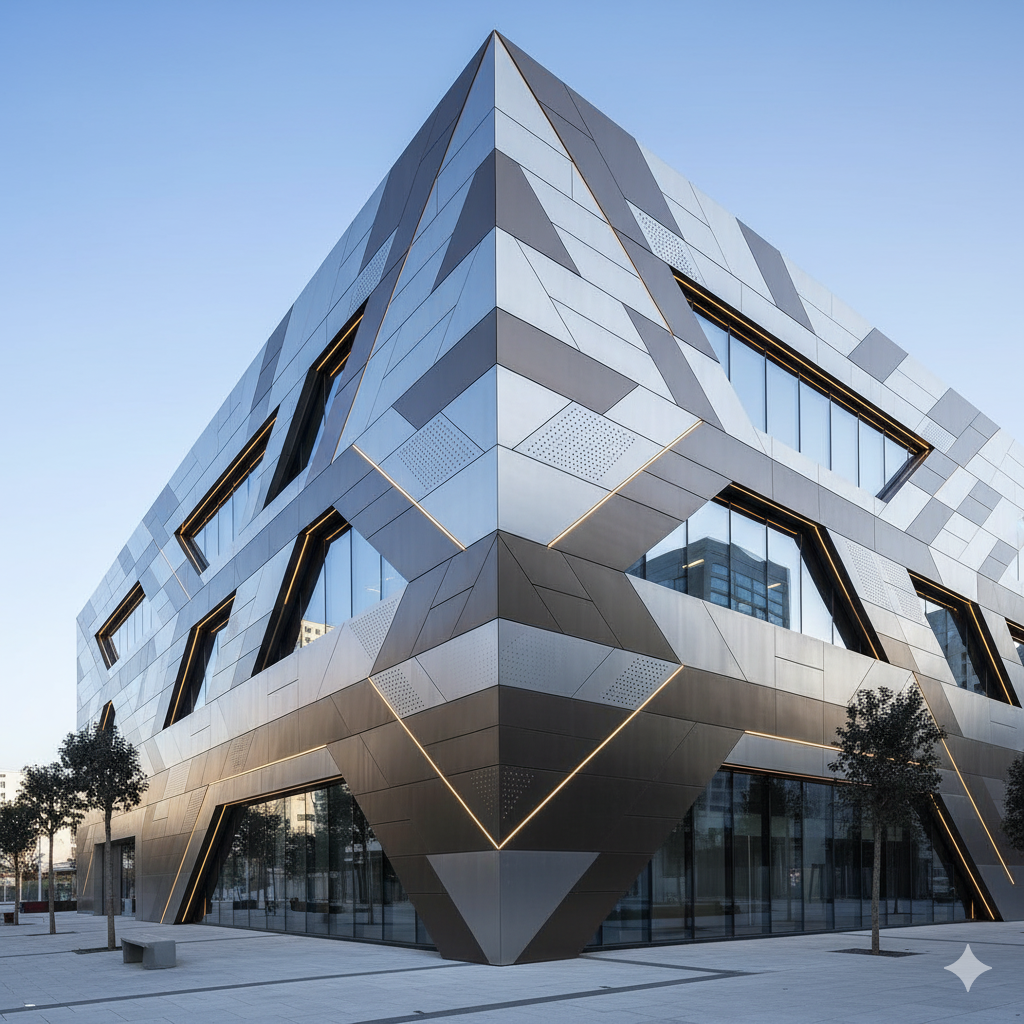
You can use laminated metal composites for exterior cladding, roofing panels, and curtain walls where aesthetic finish and weather resistance matter. These composites combine a metal skin with a core to give high stiffness at low weight, which reduces support-frame sizes and installation labor.
For structural elements, aluminium-based metal matrix composites (MMCs) provide improved strength and lower thermal expansion compared with standard alloys. That stability helps maintain tight tolerances in façades and minimizes thermal-driven joint stress.
Bullet list of practical benefits:
- Reduced dead load, enabling longer spans and lighter substructures.
- Improved abrasion and impact resistance for high-traffic façades.
- Customizable surface finishes for architectural appearance.
Automotive and Transportation Benefits
You can replace heavier steel parts with metal composites to cut vehicle weight and improve fuel efficiency or extend electric vehicle range. Typical applications include brake rotors, engine components, heat sinks, and battery housings where heat management and wear resistance are critical.
Metal matrix composites with ceramic or particulate reinforcement raise stiffness and temperature capability versus plain alloys. That lets you run components at higher loads with less deformation and reduced maintenance intervals.
Key performance points:
- Up to significant mass reduction for structural parts without sacrificing crash performance.
- Better thermal conductivity in composite heat exchangers for powertrain cooling.
- Enhanced wear life for sliding components, reducing lifecycle costs.
Industrial and Engineering Roles
You can deploy metal composites in bearings, gears, seals, and tooling where improved wear, fatigue life, and dimensional stability are required. Powder metallurgy and stir-casting routes allow reinforcement distribution tailored to load paths in a part.
In high-temperature or corrosive process environments, nickel- or iron-based composites provide a balance of mechanical strength and environmental resistance. That combination supports longer run times and fewer replacements in pumps, valves, and heat exchangers.
Practical engineering advantages:
- Targeted reinforcement placement reduces stress concentrations.
- Improved creep and fatigue resistance under cyclic loads.
- Compatibility with machining and joining methods used in existing shops.
Sustainability and Lifecycle
You can achieve lifecycle benefits through reduced material use and extended service intervals. Lighter structures cut operational energy; longer part life lowers consumption of replacement parts and associated manufacturing emissions.
Recycling pathways vary: monolithic metal composites with well-bonded reinforcements can be re-melted, while particulate- or fiber-reinforced systems may require mechanical separation or reuse in lower-grade components. Design for disassembly and specifying recyclable matrices improves end-of-life outcomes.
Sustainability considerations to apply:
- Choose recyclable matrices and compatible coatings.
- Design for ease of repair to maximize in-service lifespan.
- Quantify lifetime energy savings against recycling complexity when evaluating materials.